

Why Does Ozdikenosis Kill You? The Truth Behind the Viral Disease Search in 2026
You have probably seen the phrase “why does ozdikenosis kill you” pop up on your feed. Maybe it showed up in a TikTok caption. Maybe a friend sent you a screenshot. It sounds urgent. It sounds medical.
But here’s the short version: ozdikenosis is not real. No hospital treats it. No doctor diagnoses it. This article breaks down exactly why this viral disease search took off, and how you can spot the next fake medical condition before it fools you.
Why “Why Does Ozdikenosis Kill You” Is Trending Online
Search trends don’t care about facts. They care about clicks. Once a few people type “why does ozdikenosis kill you” into Google, the algorithm notices. It assumes the term matters. So it nudges the phrase into autocomplete. More curious people see it. More people search it. This is how a mysterious disease with zero medical evidence climbs the charts in a matter of days.
Short videos push this cycle even faster. A fifteen-second clip claiming “doctors are hiding this” grabs attention instantly. Viewers don’t stop to check medical authorities or a disease database. They just react. That reaction is exactly what fuels an internet disease myth, and it’s exactly why this topic deserves a clear-headed look.
Is Ozdikenosis a Real Disease?
Let’s answer this directly. No, ozdikenosis is not a real disease. It does not appear in the World Health Organization‘s ICD system. It has no entry in the CDC disease listings. You won’t find it in any disease classification used by hospitals or insurers anywhere in the world. If a condition sits outside every recognized disease database, doctors simply cannot diagnose it, because it doesn’t exist as a clinical diagnosis category.
You can check this yourself. The WHO keeps a public classification system here: WHO Classification of Diseases. Search it for “ozdikenosis.” You’ll find nothing. That absence is the whole story. When medical authorities stay silent on a term that claims to kill people, something doesn’t add up, and that something is misinformation.
What Does Ozdikenosis Mean?
Here’s a fun linguistic exercise. Break the word apart. “Ozdik” carries no root in Latin, Greek, or any recognized medical language. It sounds vaguely foreign, which tricks your brain into assuming it’s technical. The suffix “-osis” is the real trick here. Real conditions like fibrosis, scoliosis, and sclerosis all end this way. Your brain matches the pattern and assumes legitimacy, even though ozdikenosis meaning has never been defined by any credible source.
Is There Any Medical Evidence for Ozdikenosis?
There is none. Zero peer-reviewed studies mention it. Zero medical journals have published anything about it. PubMed, the largest index of biomedical literature, returns nothing. When scientific evidence is completely absent across every major research index, that’s not an oversight. That’s confirmation the condition was invented, not discovered.
Why Are People Searching “Why Does Ozdikenosis Kill You”?
Curiosity drives most of this. But the question itself is loaded. Notice how it assumes two things already: that ozdikenosis exists, and that it kills. That’s a classic trick used in viral health claims. The phrasing skips the “is this real” step entirely and jumps straight to “how dangerous is it.” Readers absorb that framing without even noticing.
Fear plays a bigger role than most people realize. A scary-sounding term triggers a quick emotional reaction before logic kicks in. That’s why so many people search first and question later. It’s a natural response, not a personal failing. But it’s also exactly the gap that disease misinformation slips through.
How the Viral Search Term Spreads
The spread follows a predictable pattern. Someone posts a dramatic claim. Commenters speculate. Search volume ticks upward. Search engines detect the spike and rank related content higher. Content farms notice the traffic opportunity and pump out more articles using the same keyword. Each new article adds fuel, and the cycle repeats itself.
| Stage | What Happens | Result |
| Initial post | Someone mentions “ozdikenosis” dramatically | Curiosity sparks |
| Reaction phase | Comments and shares multiply | Search volume rises |
| Algorithm response | Search engines boost the trending term | More visibility |
| Content farm response | Low-quality articles get published fast | Misinformation multiplies |
This isn’t a conspiracy. It’s just how attention economies work online, and it explains why an internet health trend can outrun the truth in less than a week.
Why the Question Sounds Scientifically Plausible
The question sounds real because of its structure. It borrows the tone doctors use. It assumes cause and effect, the same way a real medical question would. Combine that structure with a fear-based subject, and your brain treats it as legitimate before you’ve had a chance to fact-check anything.
Where Did the Term “Ozdikenosis” Come From?
Nobody can point to a verified origin. There’s no founding case, no original research paper, no early clinical report. What we can trace is the pattern behind it. Fabricated medical terms typically follow the same recipe: strange-sounding syllables, a scientific-feeling suffix, and a dramatic claim attached for shock value.
This matches how many past viral medical terms were born. Someone strings together sounds that feel foreign and clinical, slaps on “-osis” or “-itis,” and adds a scary consequence. It costs nothing to publish, and if it catches on, it generates traffic for whoever wrote it first. That’s the entire business model behind a lot of fake disease names you’ll find online.
See Also: Young18gye Explained: Meaning, Uses, Online Safety & Digital Identity
Why the Name Sounds Like a Medical Condition
Your brain is a pattern-matching machine. It has seen thousands of real medical terms over your lifetime, so it recognizes the shape of one instantly, even without understanding the content. This is called pattern recognition bias, and it’s a big reason medical-sounding words slip past our natural skepticism.
How Unverified Health Terms Become Popular
Popularity here has nothing to do with accuracy. It has everything to do with competition, or the lack of it. A brand-new term has zero competing content. That means the first article written about it can rank quickly on search engines, encouraging more writers to jump in and repeat the claim. Repetition, not evidence, builds its reputation.
Why Ozdikenosis Feels Like a Real Disease
Feelings and facts are different things, and this gap is where most of the confusion lives. Ozdikenosis feels real because it borrows every surface signal your brain uses to judge legitimacy: technical language, a serious tone, and repeated exposure across multiple platforms. None of those signals actually require truth behind them.
Think of it like a movie trailer for a documentary that was never made. The trailer looks convincing. The music feels serious. The narrator sounds authoritative. But if the film doesn’t exist, none of that presentation matters. Ozdikenosis disease claims work the same way, built entirely from presentation with nothing underneath.
The Role of Medical-Sounding Language
Jargon signals expertise, even when it’s meaningless. A sentence dressed in clinical vocabulary sounds more credible than the same idea explained in plain words. This is a documented effect in psychology, and marketers, unfortunately, use it constantly, whether they’re selling a real product or a fabricated medical condition.
How Repeated Online Claims Create False Credibility
Repetition builds belief on its own, separate from evidence. Psychologists call this the illusory truth effect. The more times you encounter a claim, the more true it starts to feel, even if you never see a single source backing it up. That’s exactly how unverified disease claims gain traction across social platforms.
Are the “Symptoms of Ozdikenosis” Real?
Search around and you’ll find lists claiming fatigue, headaches, dizziness, and weakness as signs of ozdikenosis. Here’s the catch: these are some of the most common, nonspecific symptoms in all of medicine. They show up in dehydration, poor sleep, stress, anemia, low blood sugar, and dozens of other everyday conditions. Attaching them to a fake illness doesn’t make the illness real. It just borrows credibility from symptoms that are already familiar to you.
This tactic works because almost everyone has felt tired or had a headache recently. When a symptom list feels personal, people assume it must apply to them specifically. That’s not how diagnostic criteria work in actual medicine. Real diagnosis requires much more than matching a few vague feelings to a scary label.
Why Viral Symptom Lists Can Be Misleading
Generic symptoms cast a wide net on purpose. The broader the list, the more readers feel like it applies to them. That’s good for engagement and terrible for accuracy. A responsible symptom list narrows things down using lab work, imaging, and history. A viral one does the opposite, staying vague enough to catch as many readers as possible.
How Real Disease Symptoms Get Attached to Fake Terms
Writers behind fake medical condition content often borrow real symptoms from legitimate illnesses and slap them onto their invented term. It’s an easy way to sound accurate without doing any actual research, and most readers never notice the borrowing has happened.
Why Do People Believe Viral Disease Claims?
Belief isn’t about intelligence. It’s about how our brains are wired to process fear and repetition. Even careful, educated people fall for health myths occasionally, especially when they’re tired, stressed, or scrolling quickly without pausing to verify anything.
Three mental shortcuts do most of the damage here: confirmation bias, availability bias, and fear amplification. Confirmation bias makes you notice posts that support what you already suspect. Availability bias makes repeated exposure feel like proof. Fear amplification pushes your brain toward worst-case thinking before logic gets a say. Together, they form a near-perfect storm for spreading health misinformation online.
The Psychology Behind Health-Related Search Anxiety
There’s an actual term for excessive health searching driven by anxiety: cyberchondria. It describes the loop where searching for symptoms increases worry, which triggers more searching, which increases worry further. A basic headache turns into “what if I have ozdikenosis” in a matter of minutes, purely through this feedback loop.
Why Fear Makes Medical Misinformation Spread Faster
Fear grabs attention faster than calm explanation ever could. Research on the spread of information online, including from the WHO’s own work on the “infodemic,” confirms that emotionally charged claims travel much faster than neutral, factual corrections. You can read more on this here: WHO Infodemic Fact Sheet. Fear wins the race, and truth is left playing catch-up.
How Search Engines and Content Farms Can Amplify Health Myths
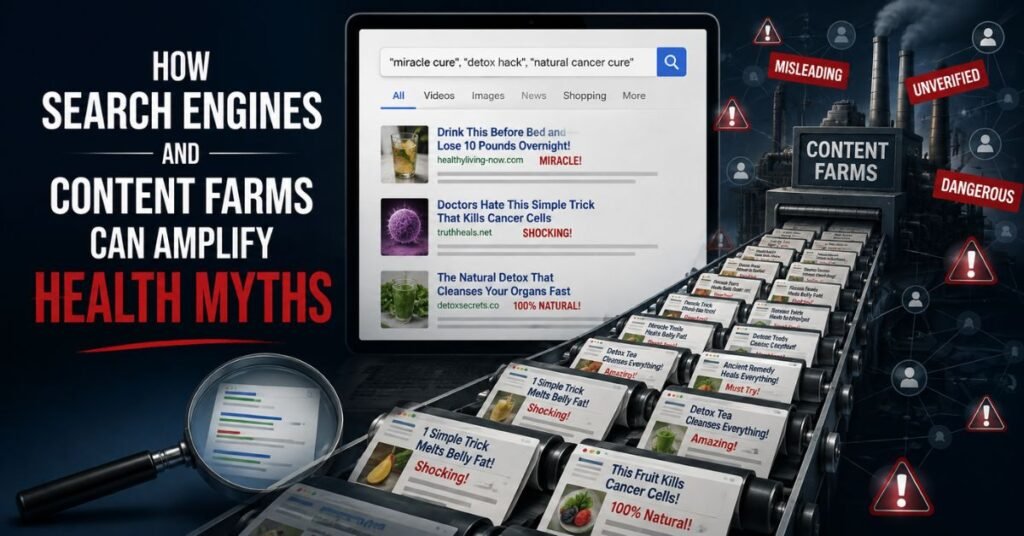
Search engines rank based on engagement signals, not accuracy checks. That single fact explains most of what’s wrong with online health myths today. A term with rising searches and rising clicks gets rewarded with visibility, whether or not a single sentence about it is true.
Content farms exploit this gap aggressively. They monitor trending, undefined keywords, then rush out AI-generated health content to fill the demand before anyone else does. Quality and accuracy take a back seat to speed, because speed is what captures the early traffic wave.
Repeated Claims and Search Visibility
Every new article using the same keyword strengthens its apparent legitimacy in the eyes of search algorithms. It looks like consensus. It’s actually just repetition from writers copying each other, often without adding a single new fact.
See Also: TheLaptopAdviser Expert Gaming Reviews 2026: Are They Trustworthy?
The Problem With Unsourced Health Content
| Source Type | Reliability | Typical Behavior |
| Medical journals | Very high | Peer-reviewed, evidence-based |
| WHO / CDC | Very high | Verified, regularly updated |
| Established health sites | Medium to high | Editorial review, cited sources |
| Unknown health blogs | Low to medium | Mixed accuracy, few citations |
| Content farms | Very low | SEO-driven, often fabricated |
This table is worth remembering the next time you read anything alarming online. Ask where it sits on this scale before you believe or share it.
What Actually Makes a Disease Fatal?
A name doesn’t kill anyone. Biology does. Real fatal illnesses cause measurable, trackable damage inside the body, and doctors can point to exactly what’s failing and why. Understanding this helps you see just how empty a term like ozdikenosis really is once you strip away the scary packaging.
Organ failure sits at the center of most fatal conditions. When the heart, lungs, kidneys, or liver stop functioning properly, the whole body suffers, because these organs support everything else running underneath the surface. Severe infection leading to sepsis is another major cause, where the body’s own immune response spirals out of control and starts damaging healthy tissue instead of just fighting invaders.
Dangerous inflammation, especially when it becomes systemic rather than localized, can shut down multiple systems at once. Circulatory and cellular problems, like blocked blood flow or oxygen starvation at the cellular level, cause damage that can become irreversible within minutes. And multi-organ dysfunction, where several systems fail together rather than one at a time, represents one of the most serious and time-critical emergencies in modern medicine.
Every one of these mechanisms has decades of clinical evidence behind it. Ozdikenosis causes and ozdikenosis treatment have none, because there’s no biological mechanism to study in the first place.
Real Medical Conditions That May Be Confused With Viral Disease Claims
Some real illnesses do get mixed up with viral internet terms, mostly because their symptoms overlap or their names sound unfamiliar to the average person. Sepsis and multi-organ dysfunction syndrome represent genuine emergencies, with clear diagnostic criteria built on blood work, vital signs, and imaging. Autoimmune diseases, where the immune system mistakenly attacks the body’s own tissue, carry decades of medical research and specific antibody testing behind their diagnosis. Mitochondrial disorders affect how cells produce energy and require genetic testing to confirm. Amyloidosis and other rare conditions, though uncommon, are documented extensively in medical journals with established treatment protocols.
The difference between these real conditions and ozdikenosis isn’t subtle once you look closely. Real conditions have lab markers, imaging results, and years of case studies. Ozdikenosis has none of that. It has blog posts and video captions, and that’s simply not the same category of evidence.
Why These Conditions Are Different From Ozdikenosis
Legitimate conditions go through rigorous clinical diagnosis processes involving tests, imaging, and specialist review. Ozdikenosis skips every one of those steps entirely, because there’s no underlying biology to test for in the first place.
Can Ozdikenosis Be Diagnosed or Treated?
No, and this is one of the clearest signs that something is wrong with the claim. Every real disease has an established diagnostic pathway, whether that’s blood tests, imaging, biopsy, or genetic screening. Ozdikenosis has none of this. There’s no lab test you can request. No doctor has a treatment protocol sitting in a drawer somewhere. The absence itself tells you everything.
Self-diagnosing from online symptoms carries real risk here, even when the disease you’re worried about turns out to be fictional. Anxiety builds. Sleep suffers. And worse, people sometimes delay seeking help for an actual condition because they’ve convinced themselves it’s something else entirely, something that was never real to begin with.
Why There Is No Established Diagnostic Process
Diagnosis requires a foundation of research: known biomarkers, imaging patterns, or genetic signatures. None of that exists for ozdikenosis, so no diagnostic pathway can exist either. It’s a logical dead end.
Why You Should Not Self-Diagnose From Online Symptoms
Self-diagnosis based on a vague symptom list is one of the riskiest habits in modern health searching. It skips professional medical advice entirely and replaces it with guesswork dressed up as certainty.
What to Do Instead if You Have Concerning Symptoms
Track what you’re actually feeling. Note when it started and how severe it is. Then bring that information to an actual doctor, who can run real tests and reach a real conclusion, instead of relying on whatever term happens to be trending that week.
How to Verify Whether a Disease Is Real
Verification isn’t complicated once you know where to look. Start with recognized trusted medical sources like the CDC or WHO. If a condition doesn’t appear there, that’s already a strong signal. Next, search for peer-reviewed studies through databases like PubMed. A real disease will have research behind it, often going back years or decades.
Recognized health organizations exist specifically to catalog and confirm legitimate conditions, so use them as your first stop rather than your last resort. You can start with CDC.gov or WHO.int. Be especially cautious with viral videos and social media posts, since these formats almost never include citations, and dramatic delivery is often used to compensate for a total lack of verified health information.
Check Reputable Medical Sources, Peer-Reviewed Research, and Recognized Health Organizations
These three checks together form a simple filter. If a claim survives all three, it’s likely legitimate. If it fails even one, treat it with real skepticism before you believe or share it further.
Red Flags That a Disease Claim May Be Internet Fiction
Certain warning signs show up again and again with disease hoax content, and learning to spot them takes very little effort once you know what to look for.
| Red Flag | What It Looks Like |
| No recognized medical sources | No mention in CDC, WHO, or medical textbooks |
| No reliable research | Zero peer-reviewed studies or clinical trials |
| Dramatic claims without support | Words like “doctors are hiding this” |
| Copy-and-paste symptoms | Identical vague symptom lists across many sites |
If you spot two or more of these signs together, that’s your cue to pause and dig deeper before believing anything further.
What Should You Do If You Feel Seriously Unwell?
Forget the viral label entirely and focus on what your body is actually telling you. Pay attention to real, specific symptoms rather than matching yourself to a trending term. Note how long something has lasted and how severe it feels, since duration and intensity matter far more to a doctor than a scary name ever will.
If symptoms are sudden, severe, or getting worse quickly, seek professional medical care right away rather than searching online first. As one physician often puts it, “the internet can describe a thousand possibilities, but only an exam can tell you which one is actually happening to you.” Online searches should inform your questions for a doctor, never replace the appointment itself.
See Also: Droven io Cloud Computing Guide: Features, Benefits, and Setup for 2026
When to Seek Professional Medical Care and Why Searches Aren’t a Substitute
Search engines can’t take your pulse, check your reflexes, or run bloodwork. Professional medical advice remains the only reliable path when something feels seriously wrong, no matter how convincing a viral post might sound in the moment.
How to Protect Yourself From Health Misinformation
Building a habit of quick verification protects you far better than trying to memorize every fake term that pops up online. Start by checking the original source of any dramatic health claim. If you can’t trace it back to something credible, that’s a red flag worth taking seriously.
Compare multiple reliable health sources before accepting anything as fact, and look for actual evidence rather than getting swept up in how viral or emotional a post feels. Avoid sharing unverified disease claims yourself, even with good intentions, since every share adds fuel to the same cycle that created terms like ozdikenosis in the first place. A little fact checking goes a long way toward building better health information literacy for yourself and everyone in your feed.
FAQ’s
Is Ozdikenosis a Real Disease?
No. It has no listing in any recognized disease database, and there’s no clinical evidence supporting its existence anywhere.
Why Does Everyone Search “Why Does Ozdikenosis Kill You”?
Mostly curiosity mixed with fear-based content designed to go viral. The loaded phrasing assumes the disease is real before any proof exists.
Are There Real Symptoms of Ozdikenosis?
No. Listed symptoms are generic and appear in hundreds of unrelated, real conditions. They aren’t unique to any single illness.
Why Does the Name Ozdikenosis Sound Medical?
It borrows common scientific-sounding patterns, especially the “-osis” suffix used in many legitimate medical terms.
Can Ozdikenosis Be Diagnosed?
No. There’s no diagnostic test, no lab marker, and no clinical pathway, because there’s no underlying disease to diagnose in the first place.
Final Takeaway
Ozdikenosis isn’t a medical mystery waiting to be solved. It’s an internet artifact, built from a convincing name and very little else. This whole trend proves something worth remembering well beyond this one term: viral health claims can look and sound convincing without carrying a single ounce of truth behind them.
The next time a scary-sounding disease crosses your feed, pause first. Check trusted medical sources. Then decide what to believe, because verification will always beat virality when your health is on the line.


