

Famous Places in Italy: 25 Must-Visit Destinations, Landmarks, and Natural Wonders
Italy brings together ancient history, Renaissance art, dramatic mountains, beautiful lakes, Mediterranean islands, historic cities, and distinctive regional cultures. From the archaeological remains of Rome and Pompeii to the canals of Venice and the peaks of the Dolomites, the country offers an enormous range of travel experiences.
For travelers planning an Italy trip, choosing where to go can be challenging because different regions offer very different experiences. Some visitors prioritize archaeological sites and museums, while others are more interested in coastlines, lakes, mountains, food, architecture, or historic towns.
This guide to the Famous Places in Italy covers 25 destinations and attractions, followed by historical sites, natural destinations, travel-planning advice, seasonal considerations, and practical tips.
What Is Italy Famous For?
Italy is particularly well known for its historical and cultural heritage. The country contains ancient Roman sites, Renaissance masterpieces, medieval towns, historic churches, archaeological areas, and distinctive regional architecture. UNESCO currently lists 62 properties in Italy on the World Heritage List, including cultural and natural properties.
Italy is also famous for its varied geography. Travelers can find the Alps and Dolomites in the north, major lakes, Mediterranean islands, long coastlines, volcanic landscapes, and historic cities throughout the country. Italy’s official tourism portal presents destinations ranging from cities and villages to lakes, beaches, mountains, and islands.
Italian cuisine and regional traditions are another important part of the country’s identity. Different areas have their own culinary specialties, ingredients, festivals, and cultural traditions, making travel between regions an opportunity to experience different sides of the country.
25 Famous Places in Italy
1. Rome
Rome is one of the most important Famous Places in Italy for travelers interested in history, architecture, art, and archaeology. The city contains layers of history extending from ancient Rome through the Renaissance and later periods.
The Colosseum is one of Rome’s best-known landmarks. Nearby, the Roman Forum provides another important connection with the ancient city. Other major attractions include the Pantheon, Trevi Fountain, and Rome’s historic center.
UNESCO recognizes the Historic Centre of Rome, including properties of the Holy See in the city that enjoy extraterritorial rights, as a World Heritage property.
2. Venice
Venice is among the most recognizable Famous Places in Italy, known for its canals, historic buildings, bridges, and lagoon setting.
Important sights include the Grand Canal, St. Mark’s Square, St. Mark’s Basilica, and the Rialto Bridge. Exploring the historic center also reveals smaller canals, bridges, churches, and historic buildings. UNESCO recognizes Venice and its Lagoon as a World Heritage property.
3. Florence
Florence is closely associated with the Renaissance and is one of Italy’s major destinations for art and architecture. It is one of the most important Famous Places in Italy for travelers interested in European cultural history.
The Cathedral of Santa Maria del Fiore, commonly called the Duomo, is the city’s defining landmark. Visitors can also explore the Uffizi Gallery, Ponte Vecchio, and Palazzo Vecchio. The Historic Centre of Florence has been a UNESCO World Heritage property since 1982.
4. Milan
Milan is a major northern Italian city known for architecture, art, culture, design, and fashion. It is one of the Famous Places in Italy that combines historic attractions with a major contemporary urban environment.
The Milan Cathedral, or Duomo di Milano, is one of its most recognizable landmarks. Other important attractions include Galleria Vittorio Emanuele II, Teatro alla Scala, and Santa Maria delle Grazie.
Santa Maria delle Grazie is particularly important because it houses Leonardo da Vinci’s The Last Supper. UNESCO recognizes the church and Dominican convent with the painting as a World Heritage property.
5. Amalfi Coast
The Amalfi Coast is one of the best-known Famous Places in Italy for coastal scenery. The area is characterized by steep terrain, coastal settlements, and views across the Tyrrhenian Sea.
Amalfi, Positano, and Ravello are among its best-known destinations. Travelers can combine sightseeing with coastal walks, local cuisine, and views of the surrounding landscape. The Costiera Amalfitana has been a UNESCO World Heritage property since 1997.
6. Cinque Terre
Cinque Terre consists of five historic coastal villages in Liguria: Monterosso al Mare, Vernazza, Corniglia, Manarola, and Riomaggiore.
The area is among the Famous Places in Italy for travelers interested in coastal villages, walking routes, terraces, and dramatic landscapes.
UNESCO recognizes Portovenere, Cinque Terre, and the Islands of Palmaria, Tino and Tinetto as a World Heritage property.
7. Lake Como
Lake Como is one of northern Italy’s best-known lake destinations and is often included among the Famous Places in Italy because of its combination of water, mountains, villages, gardens, and historic villas.
Popular places around the lake include Como, Bellagio, and Varenna. Visitors can explore lakeside towns, take boat trips, visit gardens and villas, or enjoy the scenery. Italy’s official tourism portal currently features Lake Como among its tourist destinations.
Read Also: Travel and Leisure Magazine: Exploring Destinations, Lifestyle, and Travel Tips
8. Naples
Naples is a historic city in southern Italy with a distinctive cultural identity and important archaeological connections. It is one of the Famous Places in Italy for travelers wanting to experience southern Italian history and culture.
The Historic Centre of Naples contains churches, historic streets, palaces, and other architectural features. Castel dell’Ovo is another well-known landmark.
Naples is also a useful base for visiting nearby archaeological destinations such as Pompeii and Herculaneum. UNESCO recognizes the Historic Centre of Naples as a World Heritage property.
9. Pompeii
Pompeii is one of the world’s best-known archaeological sites and one of the most significant Famous Places in Italy for understanding ancient Roman urban life.
The ancient Roman city was buried during the eruption of Mount Vesuvius in AD 79. Visitors can see streets, houses, public buildings, artwork, and other archaeological remains.
For accuracy, the UNESCO property is officially called “Archaeological Areas of Pompei, Herculaneum and Torre Annunziata.” The property includes Pompeii and Herculaneum as well as archaeological areas and villas at Torre Annunziata.
10. Pisa
Pisa is famous internationally for its Leaning Tower, but the tower is only one part of the city’s historic complex. It remains one of the most recognizable Famous Places in Italy.
The Piazza del Duomo, also called Piazza dei Miracoli, contains the cathedral, baptistery, and famous bell tower. UNESCO recognizes the architectural complex as a World Heritage property.
Visitors can combine the tower with the surrounding cathedral complex and other historic areas of Pisa.
11. Tuscany
Tuscany is a region rather than a single city, and it is known for historic towns, countryside, art, agriculture, and cultural heritage. It is essential when discussing the Famous Places in Italy because it contains several internationally recognized destinations.
Florence, Siena, San Gimignano, and Val d’Orcia are among the best-known places associated with Tuscany. The region’s countryside includes vineyards, olive groves, hills, and historic settlements.
Several Tuscan properties have UNESCO recognition, including the historic centers of Florence, Siena, and San Gimignano and the cultural landscape of Val d’Orcia.
12. Siena
Siena is a historic Tuscan city known for its medieval character and distinctive central square. It is one of the Famous Places in Italy for travelers looking for historic architecture outside the largest cities.
Piazza del Campo is the city’s best-known public space, while Siena Cathedral is an important example of Italian Gothic architecture.
The Historic Centre of Siena is a UNESCO World Heritage property.
13. Verona
Verona is a historic city in northern Italy famous for Roman, medieval, and Renaissance heritage. It is one of the Famous Places in Italy that combines historical attractions with a strong literary association.
The Verona Arena, Piazza delle Erbe, and historic center are among its major attractions. Verona is also associated with Shakespeare’s Romeo and Juliet, although the literary story should not be presented as documented history. UNESCO recognizes the City of Verona as a World Heritage property.
14. Bologna
Bologna is a historic city in Emilia-Romagna known for its architecture, university tradition, food culture, and extensive porticoes. It is an important addition to lists of Famous Places in Italy beyond the country’s most heavily visited destinations.
Important places include Piazza Maggiore and the city’s medieval towers. Its historic porticoes are particularly distinctive. The Porticoes of Bologna are listed as a UNESCO World Heritage property.
15. Sicily
Sicily is Italy’s largest island and combines historic cities, archaeological sites, volcanic landscapes, beaches, and regional traditions. It is among the most diverse Famous Places in Italy for travelers seeking several types of experiences in one region.
Palermo is an important cultural center, while Taormina is known for its historic setting and views. Mount Etna is one of Sicily’s most significant natural attractions.
Mount Etna has been a UNESCO World Heritage natural property since 2013. Sicily also contains other UNESCO-recognized properties, including Arab-Norman Palermo and the Cathedral Churches of Cefalù and Monreale.
16. Sardinia
Sardinia is a large Mediterranean island known for its coastline, beaches, landscapes, archaeological heritage, and distinctive traditions. It is one of the Famous Places in Italy for travelers interested in island scenery and cultural heritage.
Travelers can explore coastal destinations as well as historic and archaeological sites. Su Nuraxi di Barumini is a UNESCO World Heritage property representing Sardinia’s prehistoric Nuragic culture.
Sardinia also has a newer UNESCO-listed heritage element: the Funerary Tradition in the Prehistory of Sardinia – the domus de janas, inscribed in 2025.
17. The Dolomites
The Dolomites are a mountain range in the northern Italian Alps and are among the country’s most important natural landscapes. They are among the Famous Places in Italy for hiking, photography, mountain scenery, and outdoor activities.
The UNESCO World Heritage property consists of nine component areas containing 18 peaks rising above 3,000 meters. UNESCO recognizes the area for its exceptional mountain landscapes and geological and geomorphological importance.
18. Lake Garda
Lake Garda is Italy’s largest lake and extends across parts of northern Italy. Its surroundings include lakeside towns, mountains, historic sites, and outdoor activities.
It is one of the Famous Places in Italy for travelers who want to combine lakeside scenery with outdoor recreation.
Sirmione is particularly well known for its historic setting on a peninsula, while Riva del Garda is located at the northern end of the lake.
19. Matera
Matera is famous for its ancient Sassi districts, where homes and other structures were built into or around the area’s rock landscape. It is one of the most distinctive Famous Places in Italy for travelers interested in historic settlements.
The city demonstrates how communities adapted to a challenging natural environment over a long period.
UNESCO recognizes The Sassi and the Park of the Rupestrian Churches of Matera as a World Heritage property.
20. Alberobello
Alberobello in Puglia is famous for its traditional trulli, distinctive stone buildings with conical roofs. These structures make the town one of the most recognizable Famous Places in Italy in southern Italy.
The trulli are closely associated with the architectural character of the area. UNESCO lists The Trulli of Alberobello as a World Heritage property.
21. Vatican City
Vatican City is an important destination for visitors to Rome, but it should be described accurately: Vatican City is a separate sovereign state located within Rome, not an Italian city.
It is often included in guides to the Famous Places in Italy because of its location within Rome and its extraordinary cultural and religious attractions.
Major sights include St. Peter’s Basilica, St. Peter’s Square, the Vatican Museums, and the Sistine Chapel.
22. Capri
Capri is an island in the Gulf of Naples known for dramatic coastal scenery, historic sites, and Mediterranean landscapes. It is one of the Famous Places in Italy for travelers looking for an island destination near the Bay of Naples.
The Blue Grotto, Marina Grande, and coastal viewpoints are among its well-known attractions. Because Capri is an island, travelers should check current ferry and boat schedules before planning a visit.
23. Turin
Turin is a major city in Piedmont in northern Italy. It is known for historic architecture, museums, squares, and cultural institutions, making it one of the Famous Places in Italy for travelers interested in northern Italian culture.
The Mole Antonelliana is one of the city’s most recognizable landmarks, while the Egyptian Museum is a major cultural attraction.
Turin also provides access to the wider Piedmont region, known for its hills, mountains, food, wine, and cultural heritage.
24. San Gimignano
San Gimignano is a historic Tuscan hill town famous for its medieval towers and preserved historic center. It is one of the Famous Places in Italy that can easily be combined with other Tuscan destinations.
Its skyline and medieval architecture make it one of Tuscany’s distinctive small-town destinations. UNESCO recognizes the Historic Centre of San Gimignano as a World Heritage property.
25. Lake Maggiore
Lake Maggiore is a large lake in northern Italy that extends into Switzerland. Italian destinations around the lake include Stresa and the Borromean Islands.
It is among the Famous Places in Italy for travelers interested in lakeside towns, gardens, islands, historic villas, and mountain scenery.
An important factual distinction is that Lake Maggiore and Lake d’Orta lakelands are currently on Italy’s UNESCO Tentative List, not the World Heritage List. UNESCO’s current Tentative List identifies the property as a candidate for possible future nomination, so it should not be described as an inscribed World Heritage property.
Famous Historical Places in Italy
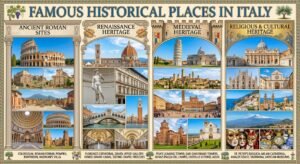
Italy has an extraordinary concentration of historical attractions. These historical destinations explain why the Famous Places in Italy appeal to travelers interested in different periods of European history.
Ancient Roman Sites
Important Roman-era destinations include:
- Colosseum in Rome
- Roman Forum in Rome
- Pantheon in Rome
- Pompeii near Naples
- Herculaneum near Naples
Pompeii and Herculaneum are particularly significant because their archaeological remains preserve extensive evidence of Roman urban life. UNESCO’s property also includes archaeological areas at Torre Annunziata.
Renaissance Heritage
Florence is central to Italy’s Renaissance heritage. Important places include:
- Florence Cathedral
- Uffizi Gallery
- Palazzo Vecchio
- Ponte Vecchio
- Historic Centre of Florence
The Historic Centre of Florence is formally recognized by UNESCO for its exceptional artistic and architectural heritage.
Medieval Heritage
Travelers interested in medieval Italy can consider:
- Siena
- San Gimignano
- Matera
- Verona
- Historic towns throughout Tuscany and central Italy
These destinations demonstrate that Italy’s architectural heritage developed through many different historical periods.
Religious and Cultural Heritage
Important religious and cultural destinations include:
- Vatican City
- St. Peter’s Basilica
- Venice’s historic churches and monuments
- Historic churches in Florence
- Medieval and Renaissance religious complexes throughout Italy
Italy’s World Heritage properties include numerous religious and cultural sites representing different periods of the country’s history.
Famous Natural Places in Italy
Italy is not only about museums and historic buildings. Its geography includes mountains, lakes, coastlines, islands, and volcanoes, adding another dimension to the Famous Places in Italy.
Mountains
- Dolomites
- Italian Alps
- Aosta Valley mountain landscapes
- Other Alpine destinations in northern Italy
The Dolomites have UNESCO natural World Heritage status. The property consists of nine areas and includes 18 peaks above 3,000 meters.
Lakes
- Lake Como
- Lake Garda
- Lake Maggiore
Each lake offers a different combination of landscapes and settlements. Lake Como, for example, combines water, hills, mountains, villages, and historic villas.
Coastlines
- Amalfi Coast
- Cinque Terre
- Capri
- Sardinia
- Sicily
The Amalfi Coast and Cinque Terre have UNESCO-recognized cultural heritage, while Italy’s islands provide different combinations of beaches, archaeological heritage, towns, and natural scenery.
Volcanoes
Two particularly notable volcanic destinations are:
- Mount Etna in Sicily
- Mount Vesuvius near Naples
Mount Etna is a UNESCO World Heritage natural property. Vesuvius is closely associated with the archaeological history of Pompeii and Herculaneum.
Famous Places in Italy for Different Travelers
Italy does not have one type of destination that suits every traveler. Your interests, budget, and available time can help determine which destinations to include.
For History Lovers
Consider:
- Rome
- Pompeii
- Florence
- Matera
These destinations provide access to different historical periods, from ancient Rome to the Renaissance and medieval heritage.
For Art and Culture
Consider:
- Florence
- Rome
- Venice
- Milan
These cities contain major museums, historic buildings, churches, galleries, and cultural institutions.
For Nature Lovers
Consider:
- Dolomites
- Lake Como
- Lake Garda
- Sardinia
These destinations offer different forms of outdoor scenery, from mountains and lakes to Mediterranean coastlines.
For Coastal Travel
Consider:
- Amalfi Coast
- Cinque Terre
- Capri
- Sicily
- Sardinia
Coastal travel in Italy can range from historic cliffside towns to islands and Mediterranean beaches.
For Couples
Popular options include:
- Venice
- Amalfi Coast
- Lake Como
- Capri
These destinations offer historic environments, waterfront settings, scenic landscapes, and opportunities for sightseeing.
For Families
Potential choices include:
- Rome
- Florence
- Lake Garda
- Venice
When traveling with children, consider walking distances, transportation requirements, weather, attraction duration, and the interests of everyone in the group.
How to Plan a Trip to Famous Places in Italy
Planning around the Famous Places in Italy is easier when you first decide which regions and experiences matter most.
Choose Destinations Based on Your Interests
Start by deciding what you want most from the trip:
- History
- Art
- Nature
- Beaches
- Food and culture
This makes a large country easier to plan because you can concentrate on destinations that match your interests.
Consider Travel Distances
Italy is geographically diverse, so it is useful to divide an itinerary into broad areas:
- Northern Italy
- Central Italy
- Southern Italy
- Italian islands
Trying to cover too many distant destinations in a short trip can leave little time to experience each place properly.
Plan Around Your Available Time
3–4 Days: Choose one major city and explore it properly rather than trying to cross the country.
5–7 Days: You can combine two or three destinations that are reasonably connected.
10–14 Days: A longer trip provides more flexibility for combining major cities with a regional destination.
Two Weeks or Longer: With additional time, travelers can explore several regions more slowly and include smaller towns or natural destinations.
Check Official Information Before Visiting
Before visiting a specific attraction, check current information about:
- Opening hours
- Ticket requirements
- Transportation
- Seasonal restrictions
- Attraction-specific visitor rules
This is particularly important for major museums, archaeological sites, religious buildings, and popular attractions.
Best Time to Visit Famous Places in Italy
There is no single season that is ideal for every part of Italy. Weather, crowds, prices, and activities vary between cities, mountains, islands, and coastal areas.
Spring
Spring can be suitable for city sightseeing and outdoor exploration. Travelers can consider historic cities, gardens, countryside, and walking destinations while checking local weather conditions.
Summer
Summer is especially relevant for coastal and island destinations, although popular areas can become busy. Mountain destinations can also provide opportunities for outdoor activities.
Autumn
Autumn can be useful for exploring cities and countryside areas. It is also an important period for regional food and cultural experiences in different parts of Italy.
Winter
Winter can be suitable for museums and historic cities as well as Alpine destinations where winter activities are available.
Rather than choosing a season simply because it is described as the “best,” consider the specific destinations and experiences you want from the trip.
Practical Italy Travel Tips
- Research attraction rules before visiting.
- Check official websites for current opening hours and ticket information.
- Book major attractions in advance when reservations are required or strongly recommended.
- Wear comfortable footwear when exploring historic city centers.
- Allow additional time for busy attractions and transportation.
- Follow visitor rules at churches, museums, archaeological sites, and other cultural properties.
- Check transportation schedules before planning day trips.
- Use official tourism and attraction websites for the most current visitor information.
Final Thoughts
The Famous Places in Italy offer a broad combination of history, art, architecture, culture, nature, and regional traditions.
Rome and Pompeii provide major opportunities to explore ancient Roman history and archaeology. Florence is closely associated with Renaissance art and architecture, while Venice is known for its canals, lagoon, and historic urban landscape.
The Amalfi Coast and Cinque Terre offer distinctive coastal scenery, while the Dolomites provide dramatic mountain landscapes. Lakes such as Como and Garda offer another type of Italian scenery, while Sicily and Sardinia combine island landscapes with cultural and archaeological heritage.
FAQs About Famous Places in Italy
What are the most famous places in Italy?
Popular destinations include Rome, Venice, Florence, Milan, the Amalfi Coast, Cinque Terre, Lake Como, Pompeii, Sicily, Sardinia, and the Dolomites.
What is Italy best known for?
Italy is known for Roman history, Renaissance art, historic cities, architecture, cuisine, mountains, lakes, islands, and coastal landscapes.
What are the most famous cities in Italy?
Rome, Venice, Florence, Milan, Naples, Bologna, Verona, Turin, and Siena are among Italy’s best-known cities.
What are the most famous landmarks in Italy?
Famous landmarks include the Colosseum, Leaning Tower of Pisa, Florence Cathedral, St. Mark’s Basilica, Milan Cathedral, and St. Peter’s Basilica.
What are the best historical places in Italy?
Rome and Pompeii are major destinations for ancient history, while Florence, Siena, Matera, San Gimignano, and Verona offer important historic and cultural sites.
What are the most beautiful natural places in Italy?
The Dolomites, Lake Como, Lake Garda, Amalfi Coast, Sicily, and Sardinia are popular natural destinations. The best choice depends on personal interests.
Is Rome or Venice better for a first trip?
They offer different experiences. Rome is known for ancient history and major cultural sites, while Venice is famous for its canals, lagoon, and historic architecture.
What are the famous coastal places in Italy?
The Amalfi Coast, Cinque Terre, Capri, Sicily, and Sardinia are among Italy’s best-known coastal destinations.
How many days do you need to explore Italy?
There is no fixed number. A short trip can focus on one city, while 10–14 days or more allows travelers to combine several destinations.


